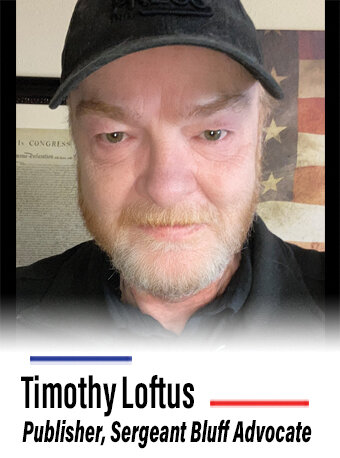
By Timothy Loftus, Editor & Publisher | Sergeant Bluff Advocate
(SBA) - Politics has always sparked debate, but in 2025, it feels like nearly every conversation teeters on the edge of conflict. Across the nation—and right here in Northwest Iowa—issues that once allowed for middle ground are now framed as all-or-nothing battles. What begins with fiery rhetoric from politicians on TV and social media quickly filters down into everyday life in Sergeant Bluff and surrounding communities. The result isn’t just a divided country—it’s divided families, strained friendships, and towns struggling to preserve the sense of unity that once defined small-town Iowa.
Fear has become the currency of modern politics. Leaders have learned that fear motivates more effectively than reason. Whether the topic is immigration, farming regulations, healthcare, or foreign policy, the language used is rarely about compromise. Instead, it’s about catastrophe—claims that the other side’s plan will destroy freedom, wreck the economy, or threaten national survival. We see this dynamic play out locally, especially in school board meetings, where discussions about curriculum or budgets can spiral into hours-long debates over indoctrination or historical erasure.
That said, I want to highlight something positive, our Sergeant Bluff-Luton School Board stands apart. Yes, its members hold diverse political views—this is America, after all—but those views aren’t aired out in meetings. I read the minutes faithfully and see a group of hardworking, dedicated individuals meeting at 6 a.m. (yes, 6 a.m.) to conduct the business that matters. Their focus and professionalism show in the high-quality education our kids receive.
Elsewhere in Northwest Iowa, however, the tone is different. Politicians may attend town halls or meet-and-greets claiming to listen to “the people,” but too often they fall back into black-and-white thinking that leaves no room for nuance. Immigration is a prime example. In Sioux City and South Sioux, immigrant workers are the backbone of meatpacking plants and local businesses. Many families in Sergeant Bluff and Salix have neighbors from Mexico, Guatemala, or South Sudan. Yet public discourse often reduces immigration to extremes—either a threat to safety and jobs or a sacred right that must never be restricted. Lost in this noise is the truth, our communities rely on immigrant families, and we need policies that balance economics, security, and humanity.
Misinformation only deepens the divide. From viral videos to misleading Facebook posts, false claims spread fast and stick. We saw this during the pandemic, when public health measures became political battlegrounds shaped more by national rhetoric than by local medical advice. Now, in 2025, the same pattern plays out in debates over climate, elections, and education. I often hear residents repeating talking points they’ve seen online—ideas that have little connection to life on the ground. These narratives spill into school board meetings, church basements, and even casual conversations at football games, turning neighbors into adversaries.
The stress this creates is real. The American Psychological Association reports that politics is one of the top sources of anxiety for Americans—and that stress is felt here in Woodbury County. Pastors say parishioners bring political fears into counseling. Families describe gatherings ruined by heated arguments. When people are told daily that disaster looms if “the other side” wins, it creates a constant sense of threat. That fear spreads, affecting children, friendships, and workplaces.
Local governance suffers too. Issues like flood protection along the Missouri River, rural hospital funding, and road maintenance aren’t partisan—they’re community concerns. Yet partisanship seeps in. A county supervisor proposing a moderate solution risks being labeled a right-wing extremist or a liberal snowflake. A school board member trying to build consensus may be shouted down. This dysfunction mirrors what we see in Washington, leaving critical local needs unmet.
Social media algorithms and cable news amplify the problem, feeding people only what they already believe. In small towns, that means two neighbors on the same street may live in completely different realities. One sees constant warnings about government overreach; the other sees daily claims that conservatives are dangerous. When they meet at the grocery store or a baseball game, finding common ground becomes harder than ever.
What’s most troubling is how normalized this has become. Falsehoods that once would have sunk a politician now often boost their support. That mindset trickles down to local life, where residents are less willing to question their sources and more likely to dig in. It erodes the trust that communities like Sergeant Bluff have long relied on.
The risks are clear. Flooding, climate impacts on crops, rural healthcare, and school funding all demand thoughtful, evidence-based solutions. But these issues are too often buried under partisan fights. For families in Sergeant Bluff, Salix, and Sloan, the cost of inaction is felt directly.
And yet, even amid deepening division, Northwest Iowa’s tradition of community continues to shine. Neighbors still show up for one another during floods. Families rally together after house fires. Residents gather at church suppers and 4-H events, keeping the spirit of togetherness alive. Just last week, the City of Sergeant Bluff hosted its 18th COMMCON—short for “Community Conversation.” This isn’t something they’re required to do once or twice a year; they choose to. It’s a proactive effort to keep residents informed about infrastructure projects, economic development, and other local initiatives that directly impact our lives. To my knowledge, no other community in the region does this. These acts of transparency and solidarity remind us that politics doesn’t have to define everything. The real challenge is preserving that community spirit and ensuring it isn’t drowned out by the noise of national division.
Extremism may dominate the headlines, but it doesn’t have to dominate our lives. The people of Northwest Iowa can choose a different path—one of nuance, truth-seeking, and treating neighbors as people first and political opponents second. That choice won’t come from Washington. It will come from living rooms, coffee shops, and classrooms across Woodbury County.
Families are fractured, friendships strained, and problems left unsolved. But history shows Americans—and Iowans—are resilient. When division becomes unbearable, people often find their way back to common ground. The hope for Northwest Iowa lies in that possibility, that we can step back from the brink, reject extremes, and do the harder, essential work of living with complexity. Only then can we begin to repair not just our politics, but our lives together.