
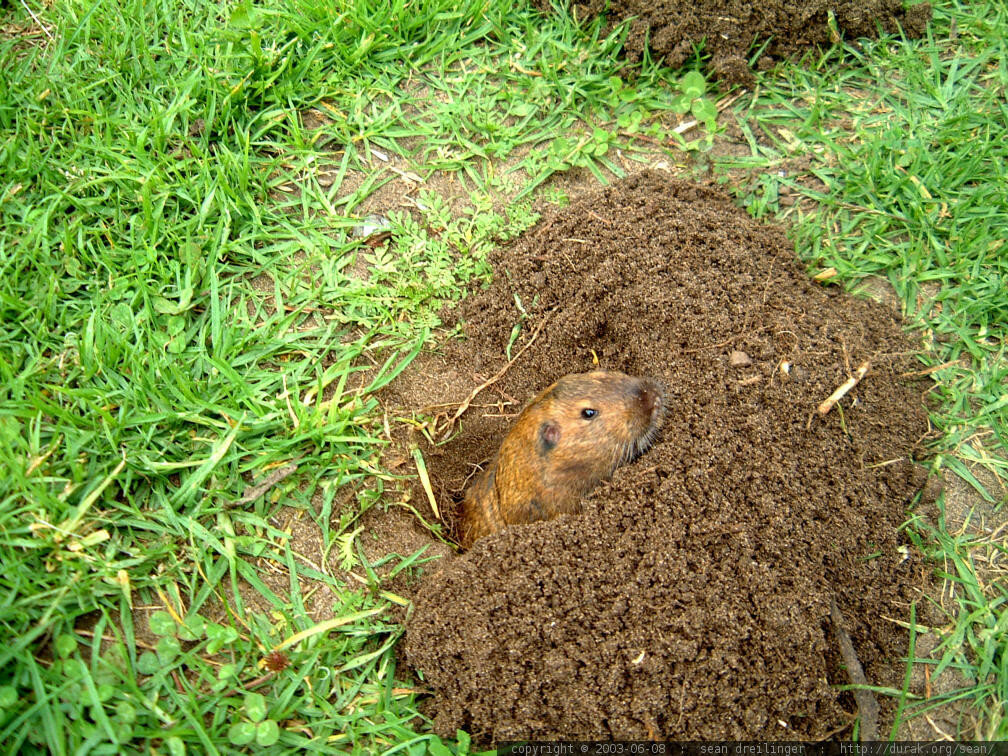
(SBA) - Although not as notorious in Iowa yards as moles, the plains pocket gopher (Geomys bursarius) can be an unwelcome guest in lawns and fields across most of Iowa, generally becoming less common in the eastern quarter of the state. It is an expert burrower, and its habit of creating dirt mounds and vigorously tunneling through soil on occasion leads to conflicts with property owners, including impairment of drainage tiles and underground utility lines, weakening of embankments along ditches and dikes, damage to mowing equipment, and diminishing the general aesthetics of lawns and other manicured areas. Pocket gophers can clip and girdle the bark of trees and shrubs and can consume the underground and aboveground portions of various garden, commercial, and ornamental plants.

Large, crescent or fan-shaped dirt mounds. Gopher mounds differ considerably from the conical (volcano-shaped) mounds made by moles.
1-3 inches wide
Sunken slightly from the surface
Contain a hole, plugged with dirt, that serves as a tunnel entrance and exit
Many are often found in close proximity
Extensive network of underground tunnels that are NOT visible from the surface
Main tunnel is 4 to 12 inches below surface
Additional tunnels for breeding and nesting 18-24 inches down
Up to 200 yards in length per individual gopher
Patches of dead vegetation may appear irregularly between mounds
Distinct from the raised ridges of soil created by moles
In addition to considering the tunnels and mounds excavated by moles, one should also make sure to rule out the narrow, surface-level pathways that meadow voles make when moving among their golf ball-sized burrows in lawns, pastures, golf courses, and other grassy habitats.
Costs and benefits of pocket gopher activity
Negative impact of pocket gophers
Cause economic loss by consuming roots, bulbs, and aboveground portions of plants. Studies in Nebraska showed a 35% loss in irrigated alfalfa and a 46% decrease of production of non-irrigated alfalfa; hay fields with grass (e.g., timothy) have shown declines ranging up to 30% in various locations.
Girdle the bark on trunks of saplings; clip off the stems of seedling trees and shrubs
Weaken or cause washouts of embankments, ditches, dikes, and levees Disfigure and diminish the aesthetics of lawns, golf courses, and other managed areas Tear through and impair drainage tiles and underground utility lines Lead to equipment damage when plows and mowers encounter mounds in fields and lawns.
Benefits of pocket gophers
Reduce compaction and improve aeration by moving and mixing considerable amounts of soil (up to 1 ton or 2,000 pounds per year per individual)
Create tunnels that in turn move more water and wait to roots of plants
Fertilize soil via defecation and bringing plants underground to decompose
Decrease surface water runoff via formation of tunnels that draw water from the surface
Stimulate topsoil formation and weathering by bringing soil to the surface
Serve as an important food source for animals in prairies, meadows, and other wild habitats
Damage control: removal of nuisance pocket gophers
In instances where pocket gophers become especially troublesome, trapping of individuals to remove them from the area can be an effective way to address damage. The first key is to find the main tunnel, which is usually located 12-18 inches away from the plug on the crescent-shaped mound. Once you have found the main tunnel, you can then place traps in the secondary tunnels, which run laterally off the main tunnel.
Locating the best place to trap or bait gophers:
Use a metal rod to probe the ground until you find the main tunnel, located 12-18 inches from the plug on the crescent-shaped dirt mound.
Once the tunnel is detected (no soil resistance on the metal probe), use a trowel to dig out soil above tunnel, typically 4-12 inches downward.
Place your bait or traps in each direction from your excavation (see details below).
Trapping to eliminate gophers: Although not particularly feasible across broad expanses like hayfields or golf course, trapping is a proven means of removing problematic pocket gophers from smaller patches, such as lawns and ditch embankments. Multiple trap styles exist, including Macabee gopher trap, Death Klutch 1 gopher and mole trap, and Victor Gopher-Getter, as well as various homemade traps.
Trap during spring and fall when gophers are most actively tunneling and mound-building.
Follow the aforementioned instructions to locate the main tunnel and to dig out a spot to place the traps.
Set and place two traps facing away from each other in both directions.
Trial and error: either leave tunnel open, thus ensnaring the gopher when it returns to repair the opening, or, like with bait placement, repair the opening yourself to keep the gopher from inadvertently burying the trap; either method can be useful, depending on the individual gopher.
Anchor flags and/or stakes with flagging to make traps easily visible when you return.
Check the trap every few hours; find a new location for any trap that fails after 48 hours.


